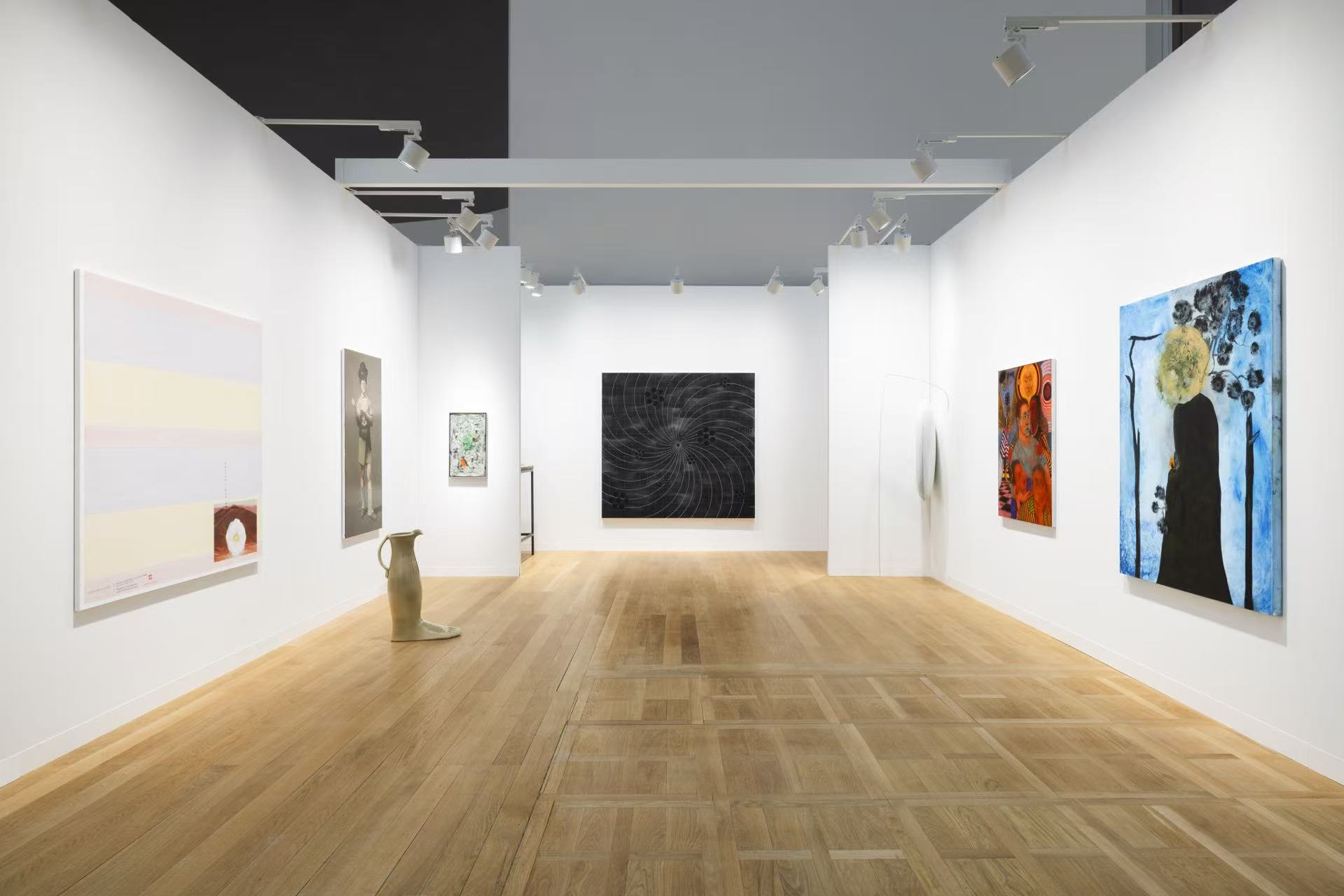
Booth 1.L15
Oct. 21 – 25, 2026
Grand Palais, Paris, FR
Participating Artists: Owen Fu, Mire Lee, Shuang Li, Hanna Hur, Arthur Marie, Stella Zhong, Leah Ke Yi Zheng, Evelyn Taocheng Wang, Stanislava Kovalčíková, and Daniel Dewar & Grégory Gicquel

Booth 1.L15
Oct. 21 – 25, 2026
Grand Palais, Paris, FR
Participating Artists: Owen Fu, Mire Lee, Shuang Li, Hanna Hur, Arthur Marie, Stella Zhong, Leah Ke Yi Zheng, Evelyn Taocheng Wang, Stanislava Kovalčíková, and Daniel Dewar & Grégory Gicquel
–
Installation View
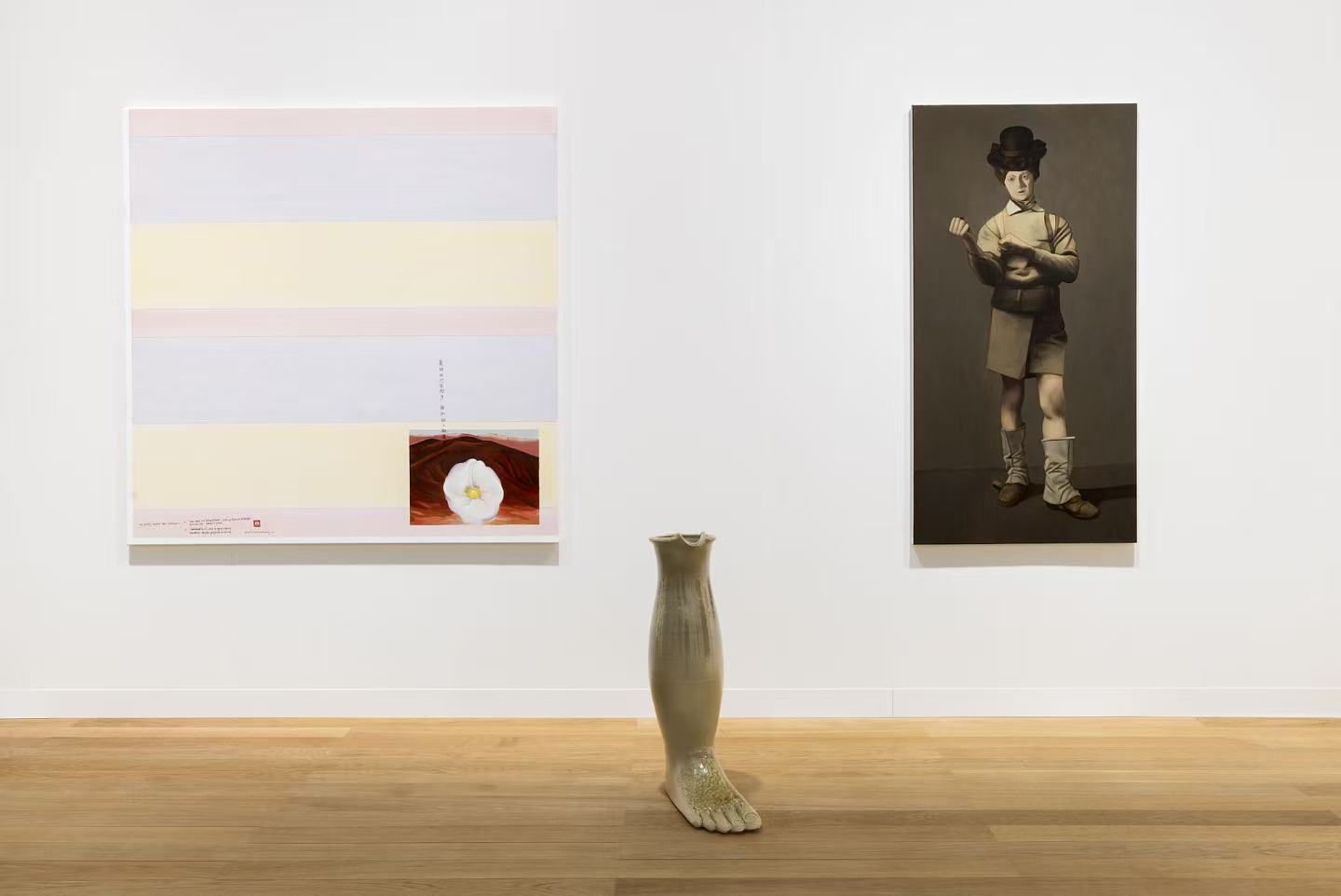
Left: Evelyn Taocheng Wang, Georgia O’Keeffe’s Ghost Ranch, Song Dynasty Poem, and Imitation of Agnes Martin, Acrylic color, pencil, gesso on canvas,155 x 155 cm,2026
Mid: Daniel Dewar & Grégory Gicquel, Stoneware vessel, Wood-fire stoneware ceramics, 83 x 61 x 24 cm, 2026
Right: Arthur Marie, Untitled, Acrylic and oil on linen, 150 x 80 cm, 2026
Evelyn Taocheng Wang brings two distinct painterly traditions into a single composition: one drawn from Georgia O’Keeffe’s Red Hills and White Flower, the other from the restrained, almost silent colour bands of Agnes Martin. A white flower is set among undulating red hills, while broad, pale horizontal bands extend across the canvas. The Song-dynasty lyric inscribed in the painting—“Her sideburns droop to greet the moon between her brows; wine-red blush rises like rosy clouds along her cheeks”—introduces another shift in the act of looking. The moon and rosy clouds are no longer simply elements of the natural world, but become metaphors for the human face.
Continuing Wang’s practice of transforming one image into another, the work establishes subtle, elusive connections between flowers, landscapes, colour bands, and the body. Through acts of recomposition and contemplation, images, language, and personal memories from different sources are layered upon one another.
In an age of additive manufacturing and rapid prototyping, the artist duo Daniel Dewar & Grégory Gicquel remain committed to their distinctive approach: combining concept and technique through the handcrafting of objects, while foregrounding and working in accordance with the inherent properties of their materials.
The lower portion of Ceramic Vessels resembles human feet, while the upper section takes the form of an ancient Greek oinochoe, or wine jug. Their distinctive design stands in striking contrast to their basic utilitarian function. On the one hand, the vessels are intended to collect human excrement, awaiting actual use; on the other, they are meticulously crafted, combining ergonomic forms with an imitation of the bodies of their users.
Arthur Marie draws his visual references from historical photographic archives, fashion magazines, medical imagery, and ephemeral images found on the internet. These source materials are dissected and deliberately stripped of their cultural and temporal markers, situating his works within a liminal space, as though suspended outside of time.
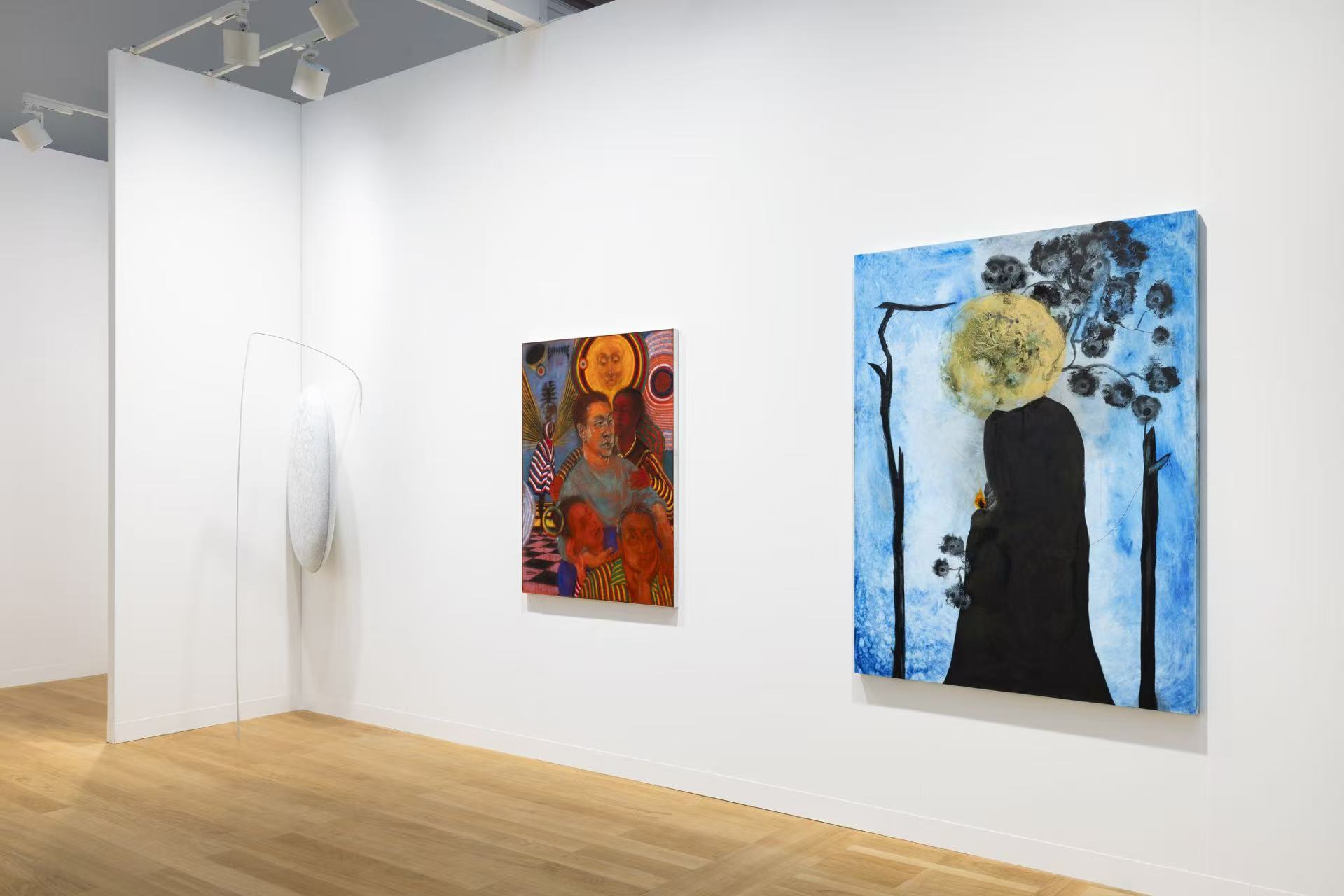
Left: Stella Zhong,Trust the High Altitude 07, Oil paint, Aqua-resin, wood, foam, wire, epoxy clay, string, bead, fluff, Overall: 211 x 69 x 61 cm (Part 1-Egg: 74 x 104 x 15 cm, Part 2-Stick: 211 x 63.5 x 1.3 cm), 2026
Right: Owen Fu, It Was Never About the Moon, Oil on canvas, 160 x 120 cm, 2026
Trust the High Altitude 07 is a sculptural work developed through the repeated transformation of the ellipse. Forms project outward from the wall and intersect with a conspicuous walking stick, while small objects on the floor or attached to the wall serve as anchors for these larger structures. Each work contains an inversion of power relations: the challenge posed by the small to the monumental destabilises direction itself, blurring the orientations of support and gravity, as well as relations of cause and effect.
Poets have always written about the moon, but perhaps what they are really writing about is never the moon itself. Rather, they write about the emotions projected onto it—longing, love, distance, and memory. The moon silently receives these feelings and preserves them for us. In this sense, the painting is also about projection: our desire to connect with others, and the ways in which we invest our emotions in an existence that cannot respond.
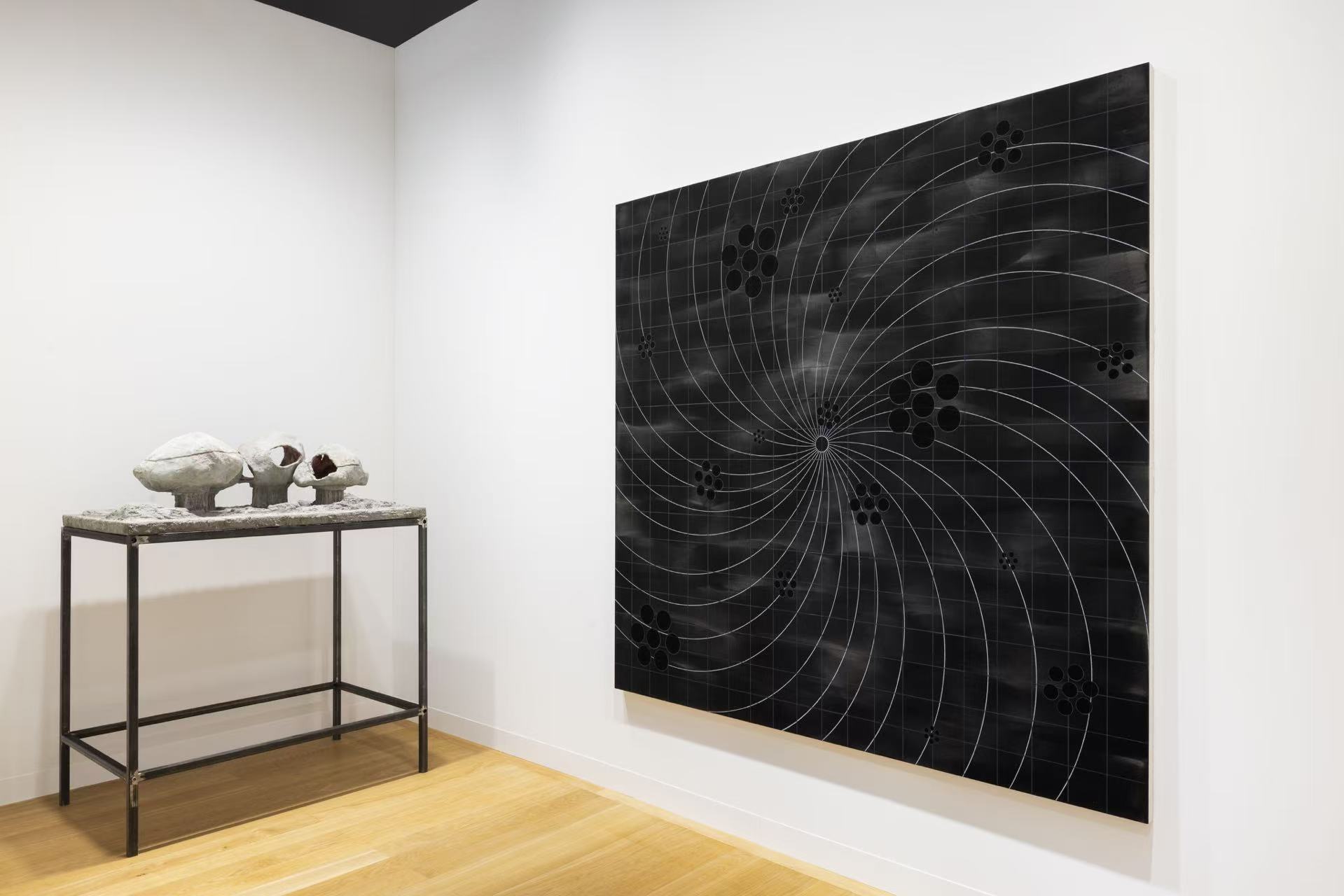
Left: Mire Lee, Endless House: Four Heads, Two of Which Open, Burlap, silicone resin, and concrete, 154 × 118 × 76 cm, 2021-2025
Right: Hanna Hur, Eye vi, Acrylic, color pencil, flashe and pigment on canvas, 193 x 203 cm, 2026
Mire Lee’s Endless House extends Friedrich Kiesler’s architectural vision of the same name, transforming architecture into a form situated somewhere between body, organ, and machine. A concrete shell encloses soft, flesh-like silicone, holding closure and openness, protection and exposure in simultaneous tension. This “endless interior” evokes both the womb-like warmth of the body and the darkness of a torture chamber. The house is no longer merely a place that contains the body, but becomes a body in its own right: continually connected to the outside world through everyday encounters, yet never fully able to open up its interior.
“We have descended into the blind world.” — Dante Alighieri, The Divine Comedy: Inferno
Hanna Hur’s paintings draw us inward through a spiral, guided by a concealed inner vision. Thin layers of black pigment resemble tidal flats left exposed as the water recedes, their surfaces marked by traces of brushwork. Straight and curved lines, geometric order and organic visual movement contend with one another. Standing before the work, viewers seem to face a trembling fissure, or a door just opened, suspended between material fact and revelation.
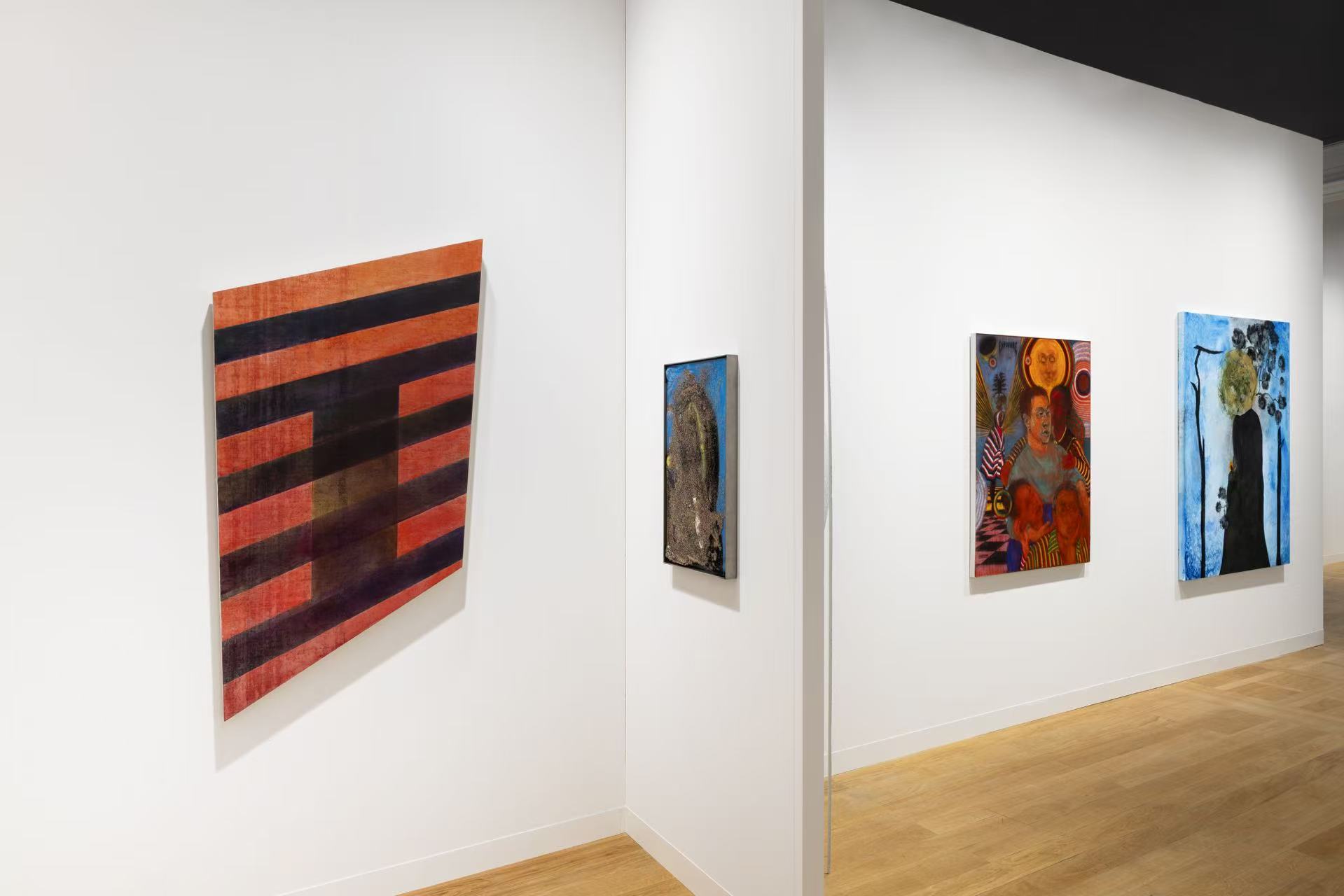
Left: Leah Ke Yi Zheng, I Ching No. 42, Oil on silk over poplar stretcher, 128.3 x 81.3 cm, 2024-2026
Right: Shuang Li, Basel ER, Epoxy resin, color sand, glitter, dust from childhood elevator, ER tag, 66.6 x 37.6 x 1 cm, 2026
Recently presented at the Renaissance Society in Chicago, Leah Ke Yi Zheng’s exhibition comprises a complete sequence of 64 paintings based on the I Ching (Book of Changes). With the completion of this sequence, each individual painting acquires new meaning through its spatial relationship to the series as a whole. I Ching No. 42, presented at the booth, corresponds to the forty-second hexagram, Yi (Increase). In relation to another painting numbered 42 currently on view at the Renaissance Society, it establishes an interconnected space between the two works. This underlying symbolic-pictorial structure enables meaning to circulate between part and whole, individual and collective.
The sharply defined boundaries of the frame govern the possibilities of the image, while the stain-like colours reveal the details of the material surface. The oscillation between figure and ground echoes the relationship between humanity and the world, as colour shifts toward the centre. Through her engagement with the I Ching, Leah seeks to apprehend and experience the myriad manifestations of the world, in the hope of making it feel a little less estranged.
Shuang Li’s resin series explores a new mode of linguistic organisation. Anonymous found objects are encased in polymer materials, collaged into a personal narrative of memory and emotion. For Li, “dust”—an seemingly insignificant substance encountered in everyday life—carries an intimate and temporal dimension. The dust was collected from an old elevator in the artist’s childhood home, which had been in operation for twenty years and was soon to be replaced. As a vehicle connecting domestic and public spaces, the elevator held traces of everyday life on its surfaces. Li carefully gathered all the dust accumulated there, treating it as a specimen of time, then interwove and sealed it together with found objects that bear their own memories.
–
Courtesy of the artists and Antenna Space.
Please scan the QR code to follow us on WeChat :天线空间ANTENNASPACE