2026.11.9 – 2027.1.10
Antenna Space, Shanghai

2026.11.9 – 2027.1.10
Antenna Space, Shanghai
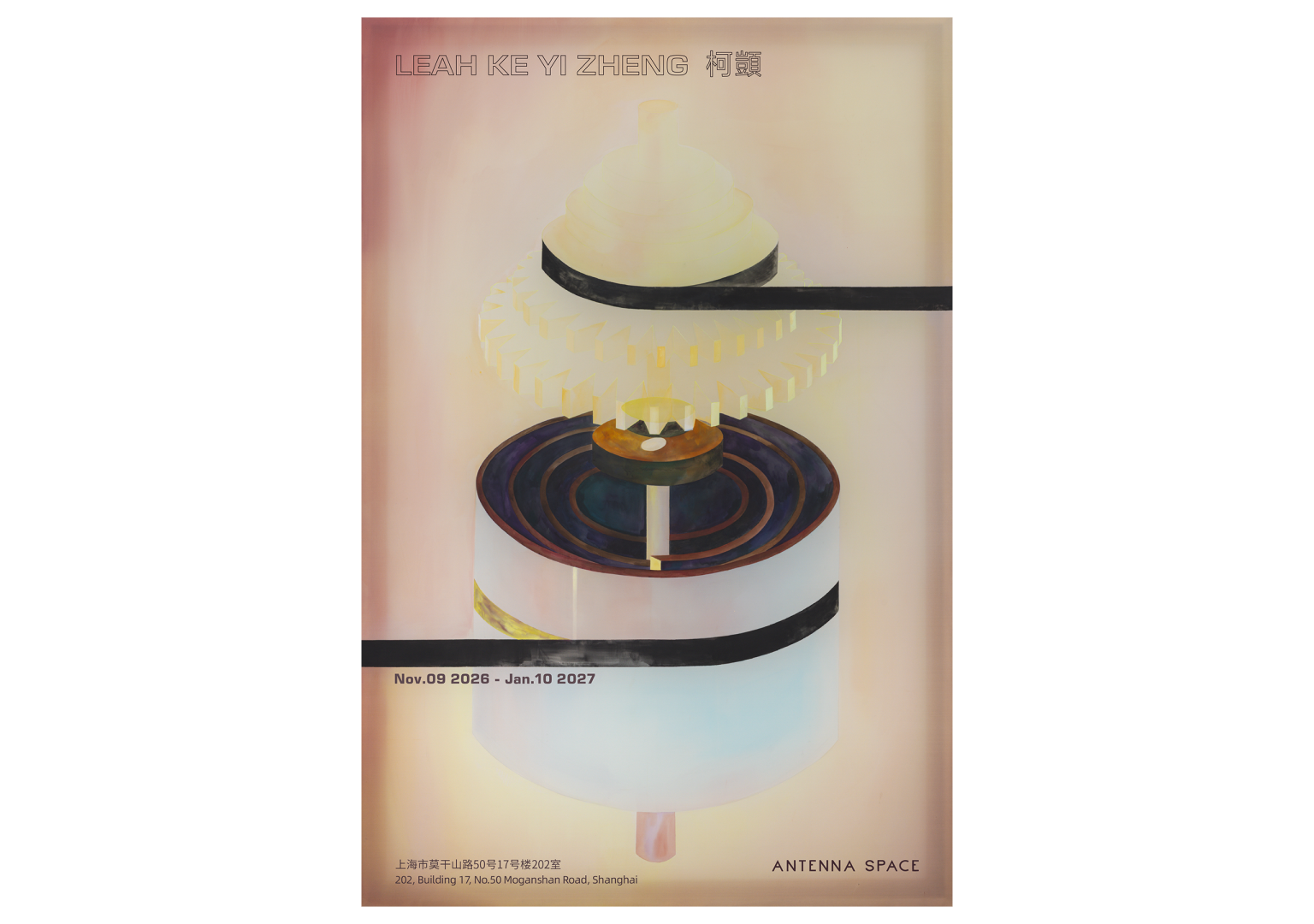
Antenna Space is pleased to announce Leah Ke Yi Zheng’s first solo exhibition in China, on view at Antenna Space Shanghai from November 9, 2026, to January 10, 2027.
–
Press Release
In her new exhibition, Leah Ke Yi Zheng continues the subtle yet potent development of her set of motifs: the machine (including the fusée and stepped reckoner, and a new appearance of a magnetometer) and the I Ching’s hexagrams, painted in diluted acrylic on silk stretched over warm-toned wood stretchers. The gallery’s architecture, layout, and window dimensions have been altered and tailored to create an interaction between natural light and the paintings.
Ke Yi Zheng first approached the boundary as an integral element of her practice in 2018, through irregularly-shaped stretchers hand-crafted in cherry wood or mahogany. Earlier this year, she unveiled her first institutional exhibition at The Renaissance Society in Chicago (the city where she lives and works), which consisted of a single artwork composed of 64 paintings depicting the totality of the I Ching hexagrams. Several interventions in the structure of that gabled hall tuned the space within the 64 paintings toward the winter and spring light of the falling sun in the West.
In her return through the insights of continual variation and change, Ke Yi Zheng’s machines harbor new asymmetries and secrets of composition. Ke Yi Zheng and her silk surfaces have become translucent membranes that process the interconnecting themes of invention, time, order, and the epiphany of difference in our contemporary industrialized moment.
The current exhibition features a prominent new technique in her Wave Paintings: the artist has painted through double-stretched silk and allowed the chance-based moiré pattern to express a dimensional field across the painting, an expression of the forces of being between. The effect is reminiscent of polarization pattern graphs of the Cosmic Microwave Background — In astronomy, these are used to trace primordial gravitational waves. No mistake. In our day-to-day life, we see moiré patterns when screens are doubled, perhaps something the machine is yet to see. In Ke Yi Zheng’s process, this fugitive phenomenon or invisible relation becomes visible, and continues to exist as a trace and vibration of energy, and a ground for the precise development of painting.
Emotion can reanimate the historical experience of technology. Ke Yi Zheng’s three small I Ching paintings operate as a coded phrase; they are “speaking,” and yet are restrained. These are text paintings without using language at all, an indefinable position between symbol, image, signification, and abstraction, like Mallarmé. In the artist’s calculus, the individual cog, detached and luminous, persists as a balancing act of presence in the stream of overabundant particles. Through self-aware involvement with light’s dynamic, Ke Yi Zheng’s works challenge the myth of painting as a static object and reveal this movement of consciousness to be an exquisite pleasure.
–
Text
Text / Hindley Wang
In her eponymous debut exhibition at Antenna Space, Shanghai, Leah Ke Yi Zheng mobilizes this peculiar interdependence of objective events in relation to the subject of painting and its objectness. From the realities constituted within it to the external spatial factors that permeate its surface—including gravity, air, light, transparency, pigmentation, and precision—Ke Yi Zheng delineates the intangible yet affective relations between the painting’s interior and what lies behind and in front of it.
Hexagrams and fusées are two of Ke Yi Zheng’s earliest motifs. Both give form to the irresistible forces of nature and time. A fusée is the pulley that corrects the imbalance of power in a mechanical watch, ensuring accurate indication of the time. The hexagrams were developed in the I Ching as diagnostic tools that captures the exact state of a situation—indicators of phenomena amid ever-evolving change, stable forms for unstable forces. Between the intangible forces of nature and attempts to represent them, the parallel gulf, spurs the motion distilled in Ke Yi Zheng’s paintings. The impossibility of the former fuels endless possibilities for the latter.
—
“The decision of destabilizing the painting’s infrastructure comes not from starting with the 0 but with the -1 dimension; it begins even before a thought of a painting could take place.” – Leah Ke Yi Zheng
Ke Yi Zheng paints in the interstice between systems and intuition. Her intuition for space forms the foundation of each painting. Beyond her early insistence on irregular stretchers, Ke Yi Zheng extends her intervention in painting into the surrounding environment. In the gallery at Antenna Space, three paintings hang on the window, their backs to the Suzhou River, acknowledging the river’s passing with their translucent bodies. Throughout the day, light fluctuates, merges with the paintings, while escaping them. Light itself is reclaimed as an objectual reality. Realities always change.
Pattern of ripple surface the Wave Paintings. Ke Yi Zheng overlaid one layer of silk onto another painted through before peeling them off to reveal the textural impression they left behind. Between enmeshment and rejection, the corporeal collision leaves a backwash of crushing waves, glistening on top.
No. 51, No. 49, and No. 19 are sequenced like breaks in a sentence: The Arousing / Revolution / Approach. Indicators break their silence and begin to speak, with all the fallacies and importance of language. Every enunciation details an impossibility—that of the insurmountable difference between signs and the reality they are tasked to describe. The semiotic turn in Ke Yi Zheng’s paintings makes concrete this abstract yet primary coincidence in ever-changing reality. Realities creat difference.
—
When Dostoevsky saw Hans Holbein’s Dead Christ in the Tomb at the Kunstmuseum Basel in 1867, he stopped in his tracks for thirty minutes. Or so his wife Anna Grigorievna Dostoevskaya recounted in her diary: the painting had a crushing impact on Fyodor Mikhailovich. He stood before it as if stunned… When I came back after fifteen or twenty minutes, I found him still riveted to the same spot in front of the painting.
The painting lays Christ’s body flat on a narrow, rectangular canvas—like a tight casket, or an open cave in the wall, where life has ceased and decay spreads. The painting of the Dead Christ is mentioned three times in The Idiot. In a moment of internal suffering and waning faith, the encounter with the dead Christ—materialized in paint—drives the young Parfen Rogojin into an existential descent. Calculated synchronicities.
On the gray wall, a long, narrow painting on a silk base presents the first mechanical calculating machine capable of all four arithmetic operations, invented by the German mathematician-philosopher Gottfried Wilhelm Leibniz in 1672. With reference to the adaptive afterlives of the Holbein painting, Leibniz’s Calculus Machine (Holbein’s Dead Christ) alludes to another mythical origin of the world as we know it today: the beginning of modern computing, and foreshadows Leibniz’s belief that the binary system could and should be the universal language of creation—some decades before his first encounter with the I Ching. Synchronicities vibrate, slipping through the porous silk, knocking at its metaphysical opacity. A hopeful restore.
Please scan the QR code to follow us on WeChat :天线空间ANTENNASPACE