2026.11.05 – 2026.11.11
Address: Jūshin Kaikan, 36 Nijuninkocho, Shimogyo Ward, Kyoto
(Presented by Antenna Space)

2026.11.05 – 2026.11.11
Address: Jūshin Kaikan, 36 Nijuninkocho, Shimogyo Ward, Kyoto
(Presented by Antenna Space)
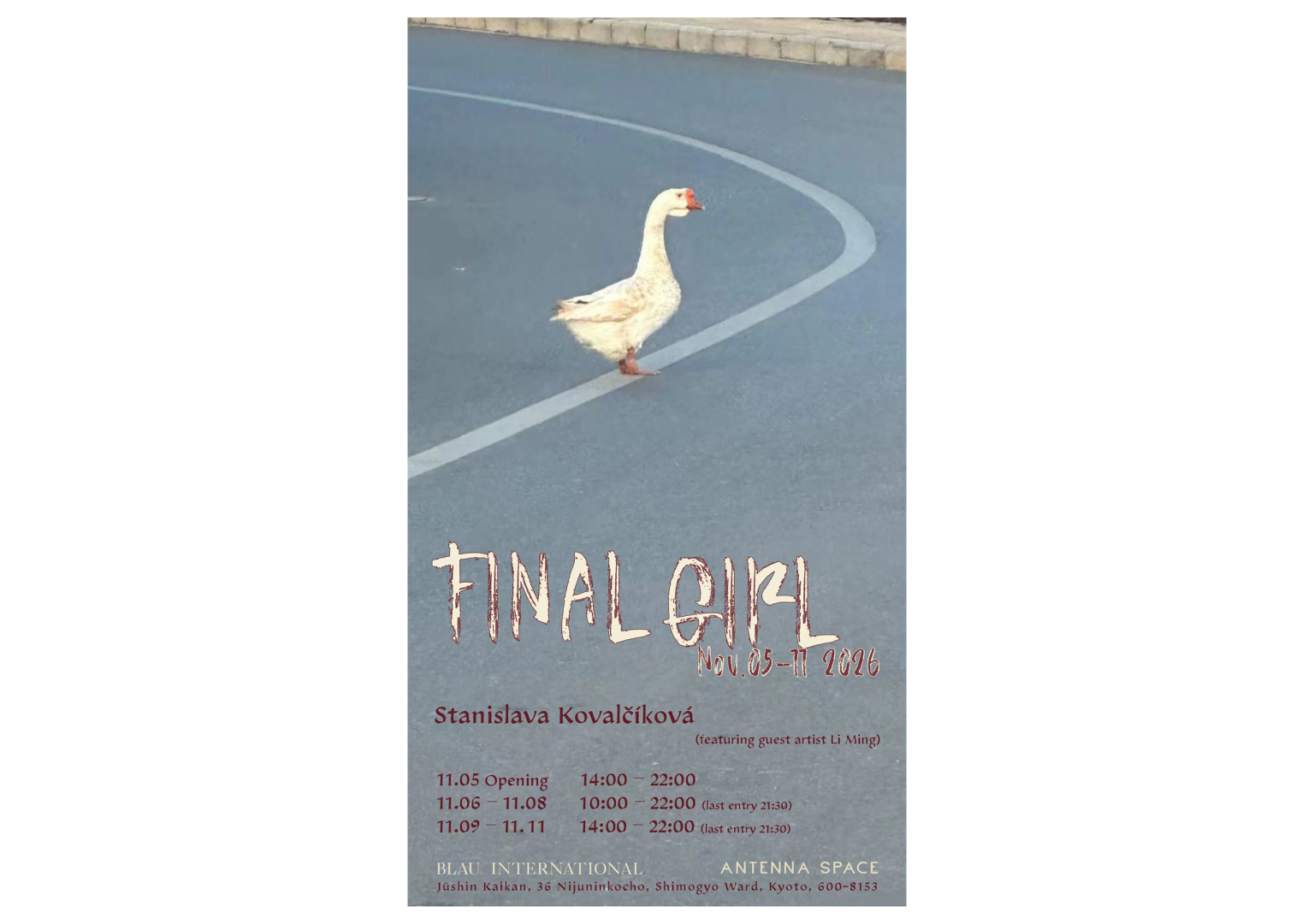
Antenna Space is pleased to announce the first presentation of Stanislava Kovalčíková’s exhibition Final Girl in Japan, at Jūshin Kaikan in Kyoto.
–
Specially Invited Artist: Li Ming
Curator: Martin Germann
Dates: November 5–11, 2026
Opening: Thursday, November 5, 2026, 14:00–22:00
Opening Reception: 18:00–20:00, co-organised with Blau International
Address: Jūshin Kaikan, 36 Nijuninkocho, Shimogyo Ward, Kyoto
Presented by Antenna Space
–
Press Release
For her first exhibition in Japan, Stanislava Kovalcikova (b. 1988) transforms parts of the former Jūshin Kaikan, a dormitory for Buddhist students, into a luminous, nocturnal environment of paintings, objects, and other materials. Evoking a soft, organic decay of Western art histories, the artist creates a site whose bodily character suggests a mirror zone between life and death. Conceived as a memorial or monument, the presentation centres on a new series of object-like paintings made using canvases filled with goose down. Additional large-scale paintings and decorative objects evoke the former dormitory’s specific functions while opening the space towards an uncertain future. The exhibition also features a selection of video works by guest artist Li Ming, whom Kovalcikova has invited to explore the former sleeping cells and more hidden spaces within the building’s labyrinthine architecture.
Kovalcikova’s practice moves fluently between painting, sculpture, and installation, treating the history of painting as something simultaneously seductive, bodily, and unstable. Her theatrical environments draw on mythology, religious imagery, and the grotesque, while textiles, mirrors, and decorative objects complicate the boundary between image and physical space. Fragments of art history and the present coexist in a blurred state of continual transformation. Li Ming’s video works likewise explore unstable relationships between bodies, images, and their surroundings. Occasionally referencing Western pioneers such as Bruce Nauman, and informed in part by his daily meditation practice, they seek different possibilities of escape. An unexpected correspondence between the two artists emerges through the figure of the fowl, linking the feathers within Kovalcikova’s paintings to Li’s pursuit of ducks in Song of the Artist—an absurd reflection on artistic agency and the artist’s life.
Completed in 1930 and designed by Midori Takeuchi, Jūshin Kaikan belongs to a moment in Japan when Western modernism and Art Deco were combined with Japanese and other Asian ornamental languages with remarkable freedom. Its former function, ornamental character, and accumulated traces of time become part of the exhibition, giving tangible form to the “grotesque, abandoned space” that Kovalcikova associates with its title. Read through the lens of Japanese horror cinema, Final Girl evokes a figure who is less a victorious survivor than someone who carries trauma forward: a witness or medium through whom memory—or a curse—persists.
“A vast portion of my life has always lived alongside ghosts,” Kovalcikova writes, connecting the exhibition to her experience of historical rupture and to “a past that refuses to die.” Her words suggest that the haunting extends beyond the building: it resides in the inherited patterns through which we live. Yet she leaves open a possibility of release: “What if the only way out is in our dreams?”
Please scan the QR code to follow us on WeChat :天线空间ANTENNASPACE